This post contains affiliate links. If you buy through them, brewing.com earns a commission at no cost to you. How we pick products
Beer · Equipment
Kegerators for Homebrew: Stop Bottling
Two days instead of three weeks, and no bottle washing. Conversion fridge versus built kegerator, the specs that matter, and what else you have to buy.
Affiliate disclosure: brewing.com earns a commission from qualifying Amazon purchases. Picks are editorial and not based on hands-on lab testing. How we pick products
Bottling is the part of homebrewing people quit over. Two hours of sanitising, filling and capping, then three weeks of waiting, to produce fifty vessels you have to wash again. A kegerator replaces all of it with one keg, one connection, and beer that is ready in two days.
The decision before the purchase decision
There are three routes to draft beer at home, and they cost wildly different amounts:
- Kegs in a fridge you already own. Two Cornelius kegs, a CO2 tank, a regulator and a picnic tap runs a few hundred dollars. It is ugly and you open the door to pour. It works perfectly.
- A conversion refrigerator. A fridge purpose-built to fit kegs with no freezer shelf in the way, which you fit with your own tower and taps.
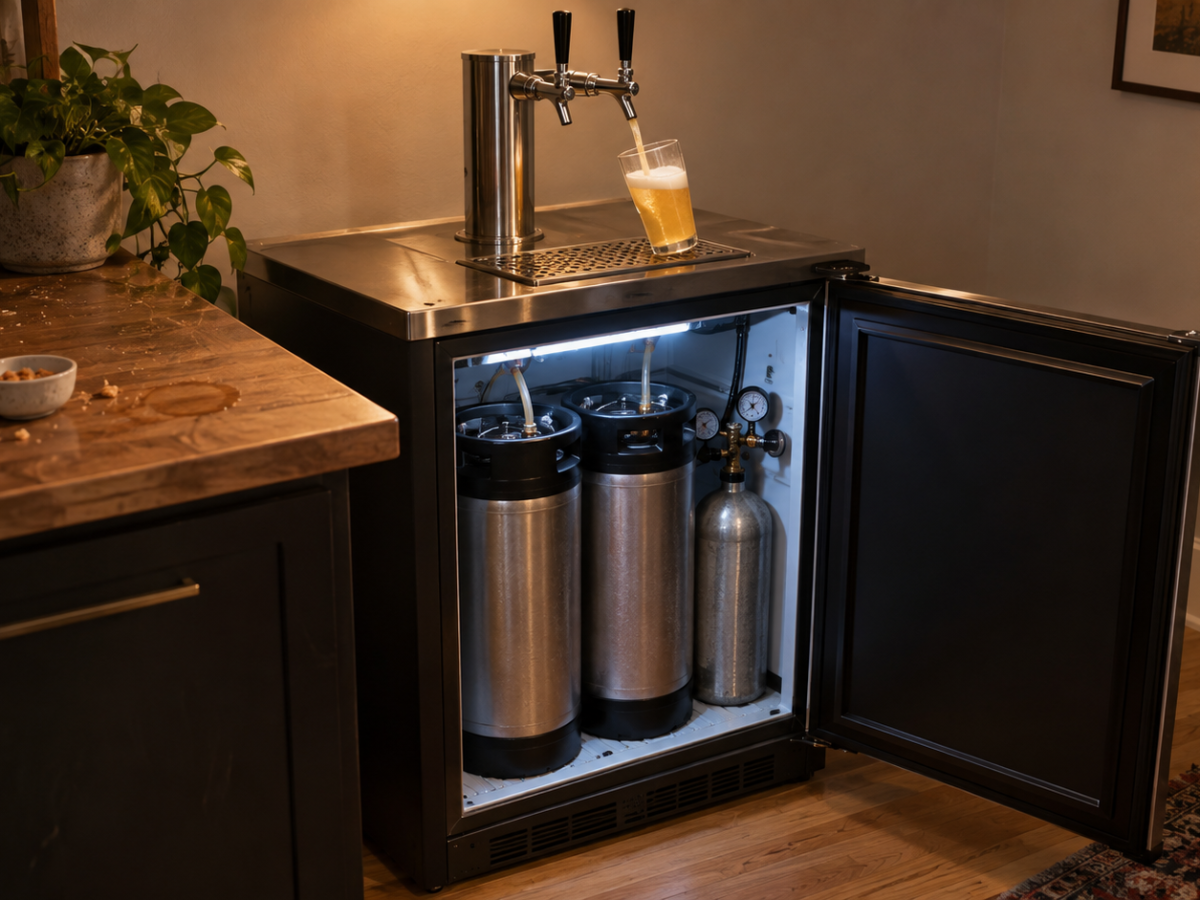
- A built kegerator. Cabinet, tower, taps, regulator and CO2 in one unit. Plug it in, connect a keg, pour.
Most people buying their first system should be honest about which of these they actually want. The fridge-in-the-garage route makes exactly the same beer.
The specifications that matter
Keg capacity, stated in Cornelius kegs. A “full size” kegerator usually takes one commercial half-barrel or two to three 5-gallon Corny kegs. If you homebrew, Corny capacity is the number you care about, and manufacturers do not always lead with it.
Tap count. One tap means one beer on at a time and a purge every time you switch. Two taps is the real quality-of-life upgrade, and the gap in price between single and double is usually smaller than the gap in daily satisfaction.
Temperature floor. Standard kegerators hold around 38°F, which is right for ales and lagers. If you want to cold-crash, lager, or serve at true cellar temperatures, check the stated low end rather than assuming.
CO2 tank placement. Inside the cabinet costs you keg room. Outside needs a pass-through. Neither is wrong; it determines whether a “two keg” cabinet really holds two kegs plus gas.
The units

Best for homebrewers
Kegco K309B-2 Double Faucet Digital Kegerator
Why it fits
Two taps, digital temperature control, and enough interior room for multiple Corny kegs, which is the configuration that suits someone brewing their own rather than buying commercial half-barrels. Kegco sells replacement parts for their towers and couplers.
Limitations
Bulky, and the included coupler is set up for commercial kegs; homebrewers will want ball-lock disconnects, which is a small extra cost.

Best single-tap cabinet
EdgeStar KC3000 Full Size Kegerator
Why it fits
A well-built full-size cabinet with a digital display, from a manufacturer that has been in this category a long time and supports it. If one beer on tap is genuinely enough, this is a lot of kegerator for the money.
Limitations
One tap. Adding a second later means a new tower, which costs more than buying two-tap up front.

Best if you already own taps
EdgeStar BR2001SS Ultra Low Temp Conversion Refrigerator
Why it fits
A refrigerator designed around kegs rather than groceries, with no interior shelving in the way and a low temperature floor that suits lagering. You fit your own tower, so you control the tap count and hardware quality.
Limitations
It is a fridge, not a finished kegerator: no tower, taps, regulator or CO2 included. Budget several hundred more to complete it.

Built-in, dual tower
EdgeStar KC7000SSTWIN Dual Tap Built-in Kegerator
Why it fits
Built-in rated, meaning it vents forward and can sit flush in cabinetry rather than needing clearance on all sides. That is the reason to spend at this level: it is the only way to get draft beer into a finished kitchen without it looking like an appliance parked in a gap.
Limitations
Expensive, heavy, and genuinely overkill unless it is going into a built-in installation.
What else you are buying
The cabinet is not the whole cost. Plan on:
- Cornelius kegs, used or new, at roughly $60–120 each. You want at least two so one can condition while the other pours.
- Ball-lock disconnects and line if the unit ships with a commercial keg coupler, which most do.
- CO2 tank and fill. A 5 lb tank carbonates and serves several batches per fill.
- A decent regulator. Dual-gauge so you can see tank pressure and serving pressure separately.
Balance your lines or you will pour foam
The single most common complaint about a new kegerator is foam, and it is almost never the kegerator’s fault. Beer line has to be long enough that its resistance matches the serving pressure. Too short and pressure dumps at the faucet, breaking carbonation out of solution as foam. For typical serving pressures, five to ten feet of 3/16″ line is the usual answer. The line that ships in the box is often shorter than that.
How these picks were made
We have not installed and run these units ourselves. Picks are based on published specifications, Corny keg capacity, tap configuration, temperature range, whether the manufacturer supports the product with parts, and the long-running consensus among homebrewers about which of these last. Prices come from Amazon and refresh nightly; large appliances go in and out of stock constantly, so confirm on the product page before committing.
Shop this guide