This post contains affiliate links. If you buy through them, brewing.com earns a commission at no cost to you. How we pick products
Beer · Equipment
All-in-One Electric Brewing Systems: How to Choose
One vessel that mashes and boils itself, so you can brew indoors. Which voltage and capacity you actually need, and the four systems worth considering.
Affiliate disclosure: brewing.com earns a commission from qualifying Amazon purchases. Picks are editorial and not based on hands-on lab testing. How we pick products
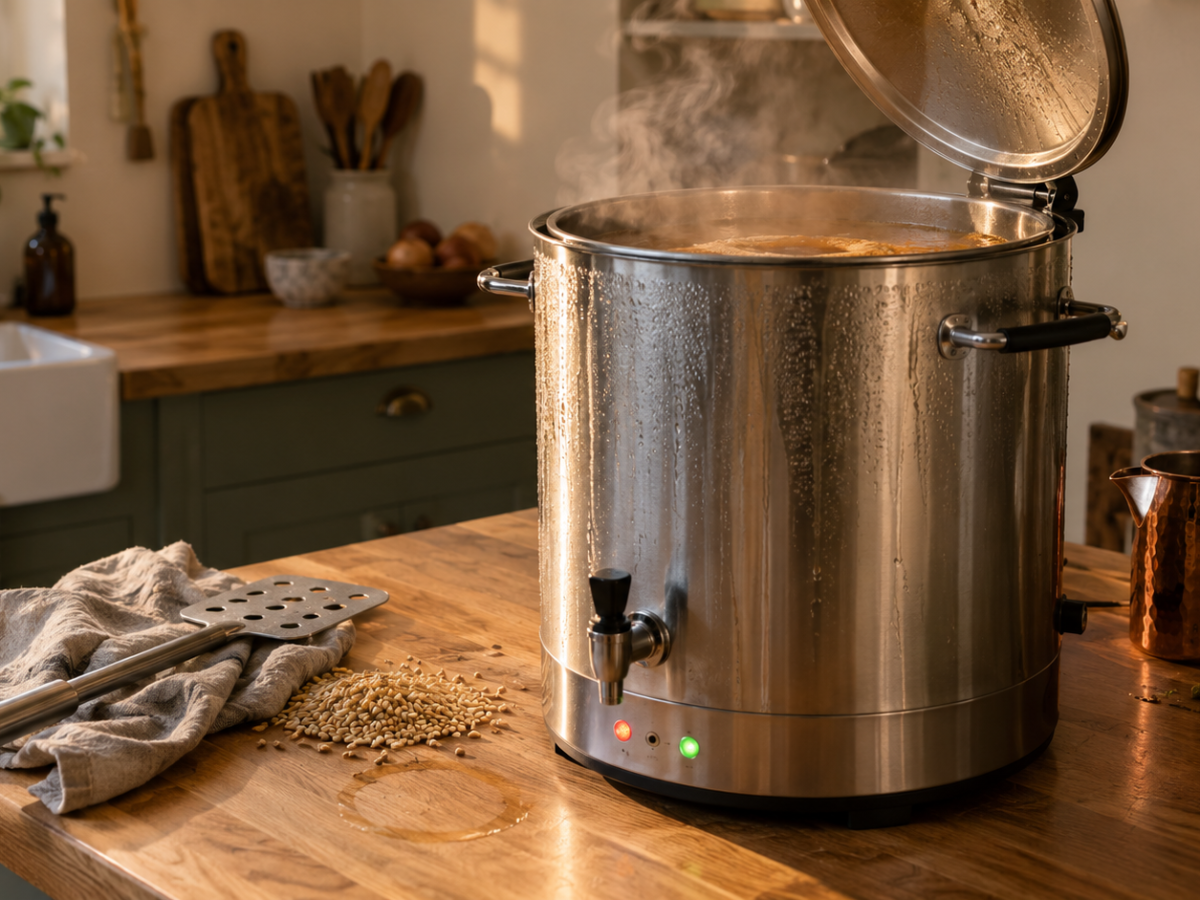
An all-in-one electric system replaces the mash tun, the boil kettle and the propane burner with a single vessel that heats itself. It is the upgrade that moves brewing from the driveway into the kitchen, and it is the most consequential purchase in all-grain homebrewing.
What these machines actually change
A traditional all-grain setup is three vessels and a flame: heat strike water in one, mash in an insulated tun, drain into a kettle, boil over propane outdoors. An all-in-one collapses that into one insulated electric vessel with a grain basket and, on most models, a pump that recirculates wort through the grain bed while it mashes.
Three practical consequences follow:
- You can brew indoors. No combustion, no carbon monoxide, no weather. This is the reason most people buy one.
- Mash temperature holds itself. A controller cycles the element to hold your target, so a 60-minute mash does not drift five degrees and change the body of the beer.
- Step mashes become trivial. Programmable controllers ramp between rests on their own, which opens up techniques that are painful with a cooler tun.
The specification that decides everything: voltage
This is the one people get wrong, and it is not recoverable after purchase.
A standard North American 110V outlet delivers roughly 1,500–1,900 watts before the breaker complains. That is enough to hold a mash comfortably, and marginal for bringing 7+ gallons to a rolling boil. Expect long heat-up times and a lazy boil on full-size batches. A 220V unit on a dryer-style circuit delivers double that and behaves like a proper kettle.
The honest rule: 110V is fine for 2.5–3 gallon batches and tolerable for 5 gallons if you are patient. If you want full 5-gallon batches without waiting, you want 220V and the outlet to run it. Budget for an electrician if you do not already have one near your brew space.
Capacity, and why the advertised number misleads
Volume is consumed by more than the beer. Grain displaces water, boil-off removes 1–1.5 gallons an hour, and trub stays behind. A rough rule is that you need about 1.5 times your target batch size in vessel capacity. A 35 litre (9.25 gallon) unit makes 5-gallon batches comfortably; a 10.5 gallon unit gives headroom for high-gravity beers where the grain bill is enormous.
Pump or no pump
Recirculation pulls wort from the bottom and returns it over the grain bed. It improves efficiency, clarifies the wort, and stops the element scorching sugars against the base. The no-pump models are cheaper and genuinely simpler, but you are giving up the main thing that makes these systems better than a cooler.
The systems

Best value with a pump
Kegland 35L BrewZilla
Why it fits
The benchmark in this category. 35 litres handles 5-gallon batches with headroom, the pump recirculates properly, and the controller does programmable step mashes. Kegland sells spare parts, which matters on a machine with a pump and an element.
Limitations
The 110V variant boils slowly on full batches; get the 220V version if you can power it. Build quality is good, not Clawhammer good.

The same machine, earlier generation
Robobrew V3 with Pump
Why it fits
Robobrew is the previous name for what became BrewZilla, from the same manufacturer. If the V3 is cheaper on the day you buy, it is substantially the same machine and a legitimate way to save money.
Limitations
Superseded by the BrewZilla revisions, so accessory compatibility can be fiddly. Check the generation before buying add-ons.
Simplest to live with
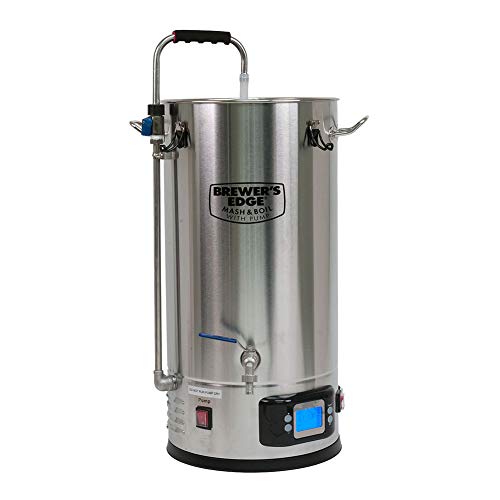
Brewer's Edge Mash and Boil with Pump
Why it fits
Fewer features and fewer things to go wrong. Holds mash temperature reliably, 110V so it runs off a normal outlet, and the interface is close to self-explanatory. A good first all-grain system for someone who does not want a project.
Limitations
110V only, so boils are slow on 5-gallon batches. Less headroom than the 35L units for big grain bills.
Buy once, cry once
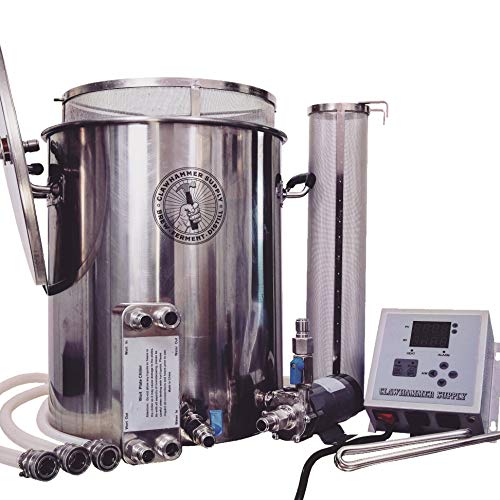
Clawhammer Supply 10.5 Gallon Electric All-in-One
Why it fits
220V, 10.5 gallons, heavy stainless throughout, and a company that answers the phone and publishes teardown and repair videos for its own machines. This is the one you buy if you expect to still be brewing on it in ten years.
Limitations
Three times the price of a BrewZilla, and it needs a 220V circuit. Overkill if you brew four times a year.
Choosing between them
- You have 220V or will run it: Clawhammer if the budget allows, 220V BrewZilla if not.
- You only have a normal outlet: Brewer’s Edge Mash and Boil, and plan on 3-gallon batches if you want a brisk boil.
- You want the most capability per dollar: BrewZilla 35L, every time.
- You brew a few times a year: honestly, keep your kettle. These systems reward frequency.
Costs nobody mentions in the listing
- A 220V circuit if you go that route. This is an electrician visit, not an afternoon.
- A wort chiller. None of these cool your wort. An immersion chiller is the usual answer.
- A grain mill, eventually. Recirculating systems are sensitive to crush; pre-milled grain from a shop is inconsistent enough to cost you efficiency points.
- Cleaning time. A pump and a recirculation path need flushing after every brew. Budget twenty minutes.
How these picks were made
We have not brewed on these machines side by side. Selections here are based on published specifications, voltage and capacity maths, manufacturer parts and repair support, and the long-running consensus in homebrewing forums about which of these hold temperature and survive. Prices come from Amazon and refresh nightly; stock on brewing equipment moves constantly, so confirm on the product page.
Shop this guide
Everything above, in one list
Add all 4 to Amazon cart ↗ Clawhammer Supply 10.5 Gallon Electric All-in-One Brewing System – Digital, Semi-Automated, 120V,…