This post contains affiliate links. If you buy through them, brewing.com earns a commission at no cost to you. How we pick products
Coffee · Equipment
Coffee Grinders Worth Buying
The grinder matters more than the brewer. Why burrs beat blades, what actually predicts frustration, and three grinders that hold a setting.
Affiliate disclosure: brewing.com earns a commission from qualifying Amazon purchases. Picks are editorial and not based on hands-on lab testing. How we pick products
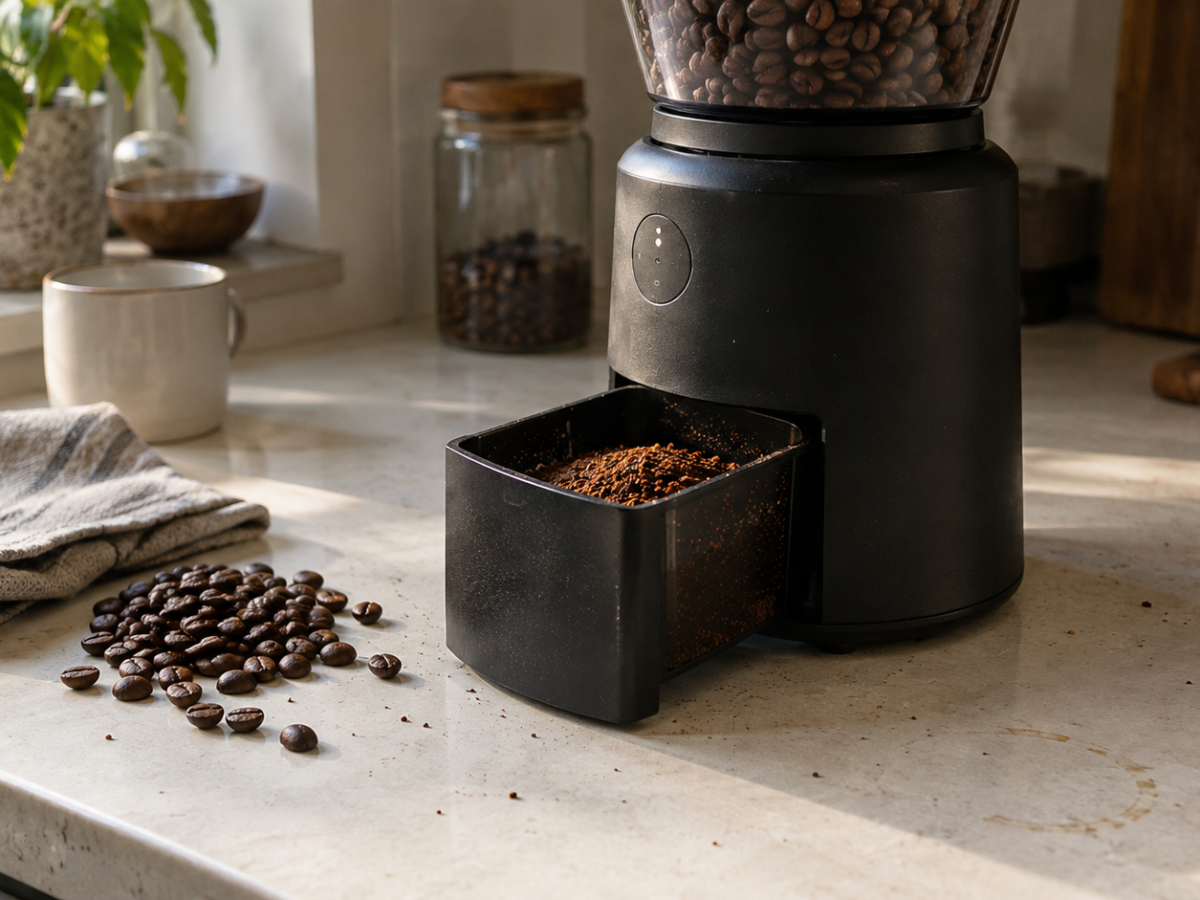
The grinder matters more than the brewer. A $300 machine fed by a blade grinder makes worse coffee than a $20 dripper fed by a decent burr grinder. If you are going to spend money on one thing, spend it here.
Why burrs beat blades, concretely
A blade grinder is a propeller in a cup. It chops whatever happens to be in its path, so you end up with a mix of powder and boulders in the same batch. That matters because extraction is a function of surface area: the powder over-extracts into bitterness while the boulders under-extract into sourness, and you taste both at once. No brewing technique fixes it.
Burr grinders crush beans between two abrasive surfaces set a fixed distance apart. Nothing passes through until it is small enough to fit through that gap, so the output clusters tightly around one size. That is the entire ballgame: uniform particles extract at the same rate, and the cup tastes like one thing instead of three.
Conical versus flat burrs
Conical burrs are a cone inside a ring. They are cheaper to manufacture, run cooler at low speeds, and produce a slightly wider particle distribution with a few more fines. Flat burrs are two facing rings that produce a tighter distribution, which espresso rewards, but they cost more and generate more heat.
For filter coffee the difference is real but small. Every grinder below is conical, which is the right call at these prices.
The specification that actually predicts frustration
Not burr material, not motor wattage: adjustment range and repeatability. Stepped grinders click into fixed positions, which makes settings repeatable but limits you to what the manufacturer chose. That is fine for filter, where being one click off is recoverable. Espresso needs finer increments than any grinder here provides, which is why none of these are espresso recommendations.
The picks

Best overall for filter
Baratza Encore
Why it fits
Forty stepped settings covering everything from fine drip to coarse French press, and the one genuinely important feature at this price: Baratza publishes parts diagrams and sells replacement burrs, gearboxes and motors. A grinder you can repair is a grinder you keep for a decade.
Limitations
Not fine enough for real espresso, and the plastic grounds bin holds static. Louder than the Capresso.
Best if you weigh nothing
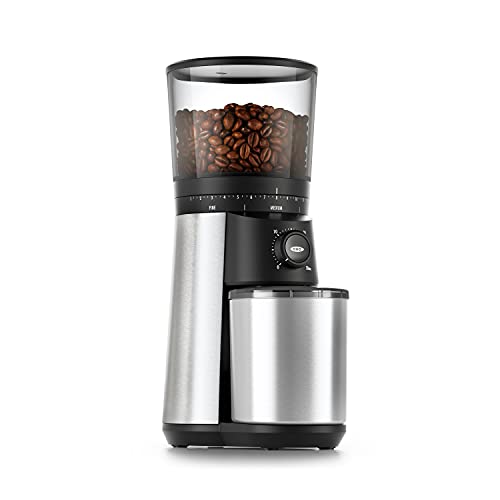
OXO Brew Conical Burr Grinder
Why it fits
Fifteen settings plus a one-touch timer that remembers your last duration, so you get a repeatable dose without pulling out a scale. The stainless housing sheds static better than plastic bins do.
Limitations
Fifteen settings is a coarse ladder next to the Encore's forty; you will sometimes want a click that does not exist. No parts program to speak of.
Best under $100
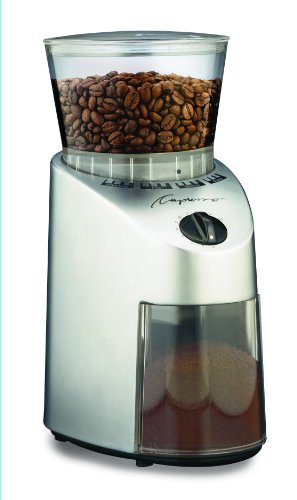
Capresso Infinity Conical Burr Grinder
Why it fits
Sixteen settings, noticeably quieter than the Encore, and it holds a grind well enough for drip and press. The cheapest machine here that still produces genuinely uniform grounds.
Limitations
Slow, and the hopper and bin are lightweight plastic that cling to fines. Treat it as a filter-only grinder.
How to choose between them
- You brew filter and want to stop thinking about it: the Encore. The repairability is the reason, not the forty settings.
- You want dose consistency without a scale: the OXO, for the timer.
- You want the cheapest real burr grinder: the Capresso.
- You want espresso: none of these. Espresso needs stepless or micro-stepped adjustment, and a grinder that costs more than the machines above.
Two habits worth more than an upgrade
Grind immediately before brewing. Ground coffee stales in minutes, not days, because grinding multiplies the surface area exposed to oxygen. This single change does more for the cup than moving up a grinder tier.
Deal with static. A drop or two of water stirred into the beans before grinding, sometimes called the Ross Droplet Technique, collapses static almost entirely. Grounds stop clinging to the bin, and your dose stops varying by a gram depending on humidity.
Cleaning, briefly
Old grounds go rancid inside the burr chamber and taint everything after them. Brush the burrs out monthly. Every few months, take the upper burr out and clear the chute properly. Do not put burrs in water; they are steel and they will rust.
What we did not test
We have not run these grinders side by side in a lab or measured particle distributions ourselves. These picks come from published specifications, manufacturer parts support, and the long-running consensus among home coffee people. Prices above come from Amazon and update nightly; availability changes without warning, so confirm on the product page before buying.
Shop this guide